Unwanted Ease
Cover Image by tjevans from Pixabay
By Althea Need Kaminske
AI and learning has been in the news recently. The Economist recently featured data from a study of 7-12 grade Chinese students’ homework and exam scores and AI use (1). Students who relied heavily on generative AI to complete their homework scored highly on their homework, but did not fare as well on exams. However, students who either didn’t use generative AI, or who only used it strategically, did not perform as well on their homework, but performed better than their peers on their exam. Wired featured a study about AI assistance and problem solving (2). Half of the participants were asked to solve 12 fraction problems with an AI assistance available. Then, without warning, the AI assistant was removed from the last 3 problems for a total of 15 problems. The other half of the participants never had access to the AI assistant and simply solved 14 fraction problems. For the first 12 problems, the AI assisted group out-performed the non-AI group, but the pattern reversed for the last three problems. Both of these studies show a pattern that is familiar to memory researchers: conditions that are easy initially do not necessarily translate to durable learning.
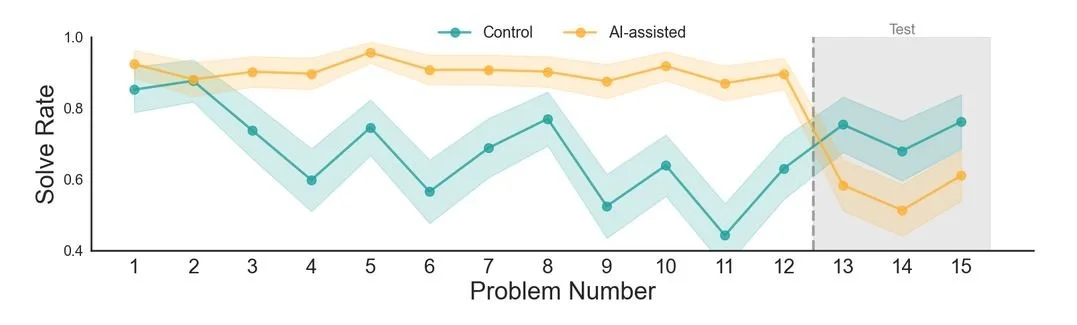
Figure from Liu et al. (2026) https://ai-project-website.github.io/AI-assistance-reduces-persistence/
One of the things that struck me about the graph from Liu et al., is how closely it resembled the pattern that we often talk about with a study from Taylor & Rohrer (2010) about interleaving. They found that students who practiced problems in the blocked condition out performed those in the interleaved condition during practice, but the pattern reversed at test. If you’ve read Make It Stick, you might recall a similar story about practicing baseball pitches: game day performance on curveballs only improved if training was interleaved and instead of blocked. Interleaved practice is harder - you don’t know what type of problem/pitch you’re going to get - but it’s more durable. Doing the extra bit of work to discern what type of problem/pitch you’re dealing with and then selecting the appropriate strategy helps you to apply the same skill in other scenarios.
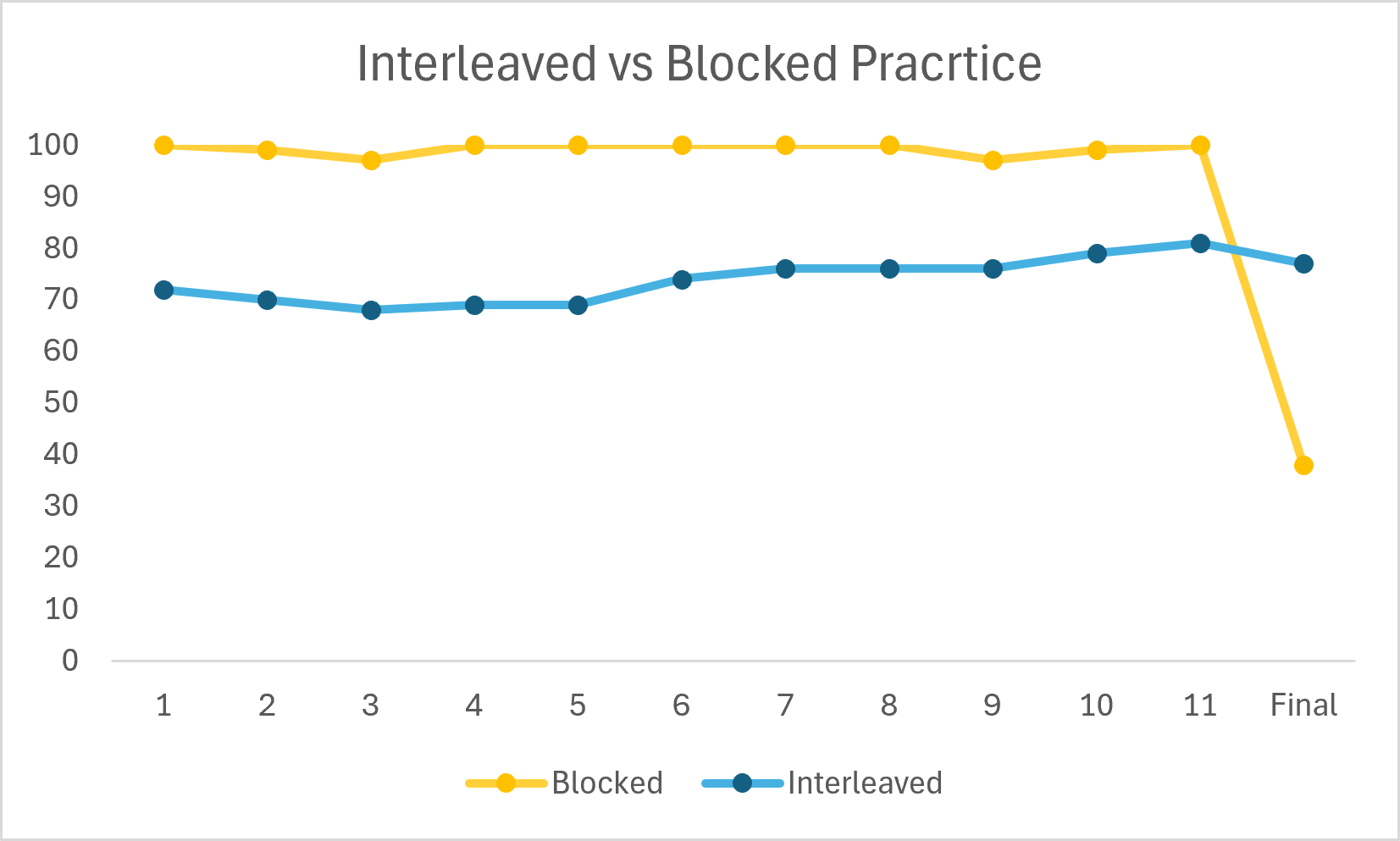
Figure recreated from Taylor & Rohrer (2010).
Similarly, when we discuss evidence for spaced practice compared to massed practice, we see the same pattern. The dirty secret that I share with students is that cramming works, but only in the short-term. Massed practice leads to higher performance on immediate tests of memory, but lower performance on delayed tests compared to spaced practice (4). This time the effect is attributed to the difference in strategies employed when retrieving information from short-term versus long-term memory. In the case of massed practice you don’t have to engage in effortful retrieval from long-term memory. You know the answer because you just saw it recently. However, when practice is spaced you don’t have ease of access from short-term memory so you have to engage in more effortful retrieval from long-term memory.
Finally, we see the same pattern when we examine the effects for retrieval practice compared to re-reading. Re-reading a passage leads to greater memory for that passage compared to repeated retrieval, but only if the test is immediate. After a delay the benefits of re-reading drop off substantially, and retrieval practice emerges as a powerful learning strategy (5). The exact mechanism, or cognitive process, that leads to the benefit of the more difficult strategy may vary somewhat between interleaving, spacing, and retrieval practice, but the overall pattern is the same. The easier condition may lead to higher initial performance, but harder condition leads to better learning.
Now, before we get carried away with the idea that difficulty is always good, it is important to note that this only works if the difficulty is within reason. If the task is too challenging then that can hinder learning performance. This is another theme within education and cognitive research: learning should be just challenging enough, but not too challenging. Much like porridge, it needs to be just right. There are several names for this. In Education, Vygotsky described this as the Zone of Proximal Development (6). In cognitive psychology we discuss desirable difficulties (7).
While we have discussed the downside of ease, and the need or desire for difficulty, for at least a hundred years since Vygotsky, the new conversation around AI assistance in learning has thrown difficulty into sharp relief. There were easier options before, but AI assistance is MUCH easier than we could have achieved without. It’s forcing a broader conversation about what, exactly, we want. What is the point of homework? Is it to do get good grades, or is it to practice and learn? What is the point of engaging in any task, for that matter? Is it to get it done or is it for the sake of the task? In more modern parlance, I’ve seen broader discussion of the concept of “friction-maxxing”, intentionally seeking out the more challenging option in daily life. As a Hoosier, I feel compelled to point out that this idea that we don’t want life to be too easy is something the Kurt Vonnegut remarked on:
“I work at home, and if I wanted to, I could have a computer right by my bed, and I’d never have to leave it. But I use a typewriter, and afterward I mark up the pages with a pencil. Then I call up this woman named Carol out in Woodstock and say, “Are you still doing typing?” Sure she is, and her husband is trying to track bluebirds out there and not having much luck, and so we chitchat back and forth, and I say, “Okay, I’ll send you the pages.”
Then I go down the steps and my wife calls, “Where are you going?” “Well,” I say, “I’m going to buy an envelope.” And she says, “You’re not a poor man. Why don’t you buy a thousand envelopes? They’ll deliver them, and you can put them in the closet.” And I say, “Hush.”
So I go to this newsstand across the street where they sell magazines and lottery tickets and stationery. I have to get in line because there are people buying candy and all that sort of thing, and I talk to them. The woman behind the counter has a jewel between her eyes, and when it’s my turn, I ask her if there have been any big winners lately.
I get my envelope and seal it up and go to the postal convenience center down the block at the corner of Forty-seventh Street and Second Avenue, where I’m secretly in love with the woman behind the counter. I keep absolutely poker-faced; I never let her know how I feel about her. One time I had my pocket picked in there and got to meet a cop and tell him about it.
Anyway, I address the envelope to Carol in Woodstock. I stamp the envelope and mail it in a mailbox in front of the post office, and I go home.
And I’ve had a hell of a good time. I tell you, we are here on Earth to fart around, and don’t let anybody tell you any different.”
References
Stromberg, D., Lei, V., & Wu, Y. (2026). The Generative AI Learning Penalty: Evidence from Chinese Secondary Education, preprint. http://dx.doi.org/10.2139/ssrn.6868618
Liu, G., Christian, B., Dumbalska, T., Bakker, M. A., & Dubey, R. (2026). AI Assistance Reduces Persistence and Hurts Independent Performance. https://ai-project-website.github.io/AI-assistance-reduces-persistence/
Taylor, K., & Rohrer, D. (2010). The effects of interleaved practice. Applied Cognitive Psychology, 24(6), 837–848. https://doi.org/10.1002/acp.1598
Rawson, K. A., & Kintsch, W. (2005). Rereading Effects Depend on Time of Test. Journal of Educational Psychology, 97(1), 70–80. https://doi.org/10.1037/0022-0663.97.1.70
Roediger, H. L. III, & Karpicke, J. D. (2006). The power of testing memory: Basic research and implications for educational practice. Perspectives on Psychological Science, 1(3), 181–210. https://doi.org/10.1111/j.1745-6916.2006.00012.x
Eun, B. (2019). The zone of proximal development as an overarching concept: A framework for synthesizing Vygotsky’s theories. Educational Philosophy and Theory, 51(1), 18–30. https://doi.org/10.1080/00131857.2017.1421941
Bjork, E. L., & Bjork, R. A. (2011). Making things hard on yourself, but in a good way: Creating desirable difficulties to enhance learning. In M. A. Gernsbacher, R. W. Pew, L. M. Hough, & J. R. Pomerantz (Eds.), Psychology and the real world: Essays illustrating fundamental contributions to society (pp. 56–64). Worth Publishers.