This Thanksgiving, Be Thankful for Forgetting
By Megan Sumeracki
This semester, I’m teaching a hybrid class that only meets on Thursdays. Because of this, we have met every week up until this week. However, with Thanksgiving break, my students will have a two-week gap right at the end of the semester. We will return from Thanksgiving break in early December, with the final exam looming around the corner.
These are particularly extreme circumstances, and some students will only have a few days off this holiday. Still, it’s common to come back from Thanksgiving break to hear “I can’t remember.” Or, even more concerning, the “wait, when did we learn this?” question.
As a cognitive psychologist specializing in learning, I’m not overly concerned. It’s counterintuitive, but forgetting is actually an extremely important part of remembering. It’s easier to understand why when we consider how forgetting occurs over time, and how spaced practice works.
In the 1880s, Hermann Ebbinghaus mapped the forgetting curve (1). He showed that forgetting tends to happen very rapidly at first, and then slows down. He also showed that spreading out repetitions was more efficient than massing them, or cramming. We know from a wealth of research in the last 140 years that spaced practice slows the rate of forgetting. This research has confirmed, many times over, that cramming does not work in the long run. Instead, spacing practice leads to much more durable long-term learning and remembering (2).
Why does spacing help? When we review information after some time has passed, it has started to fade. When we revisit the information—or better yet, when we retrieve the information—it takes effort. That effort is sometimes called a desirable difficulty, and it helps produce durable learning (3). Each time we successfully retrieve something, it becomes easier to retrieve the next time, and it is forgotten more slowly afterward. In other words, a little forgetting sets the stage for more durable remembering.
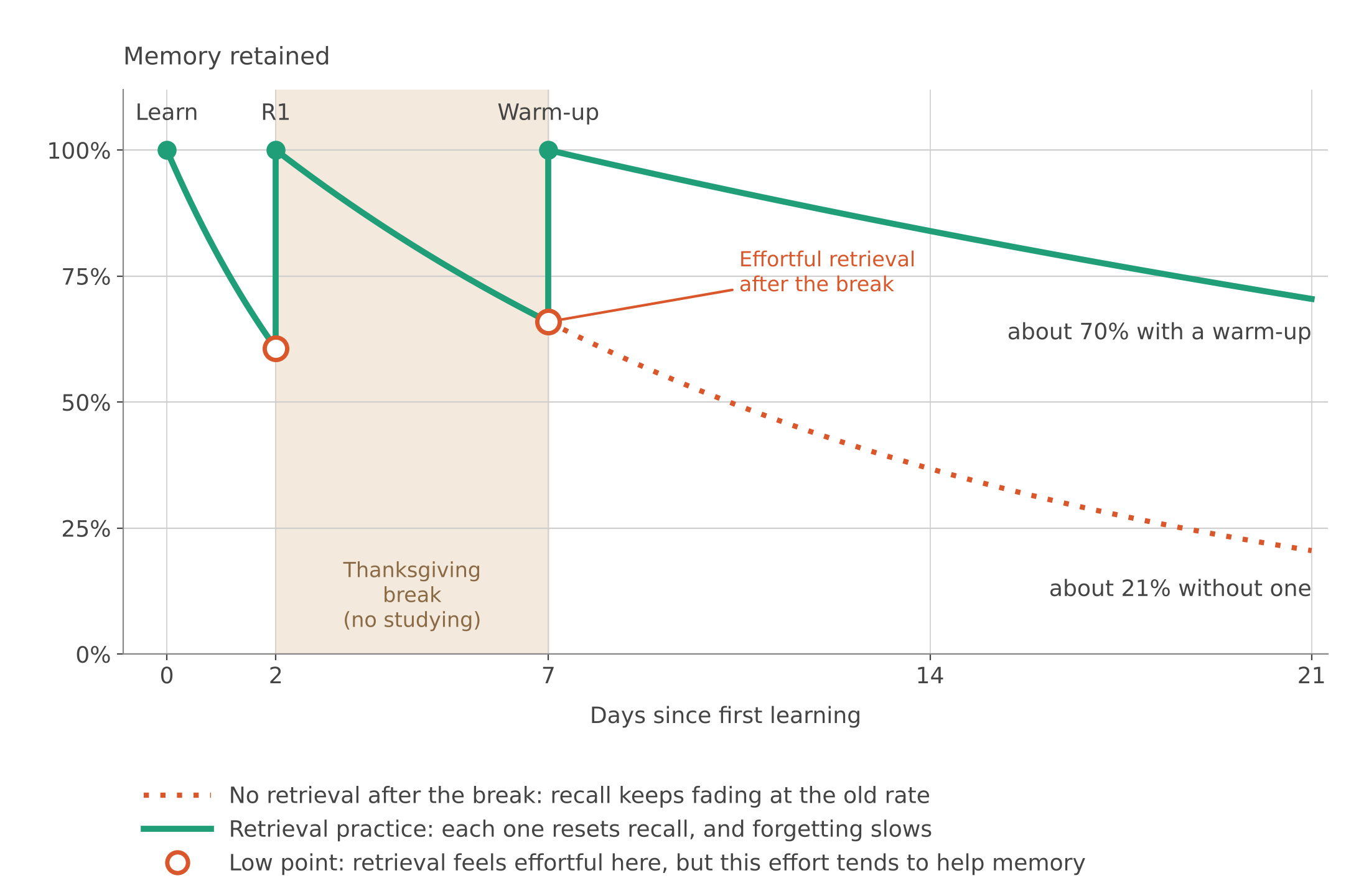
Having a break for Thanksgiving provides a natural space to let students forget a little bit, and then give them a boost upon returning. The figure below shows curves that illustrate the general pattern reported in research on forgetting (e.g., 1, 2).
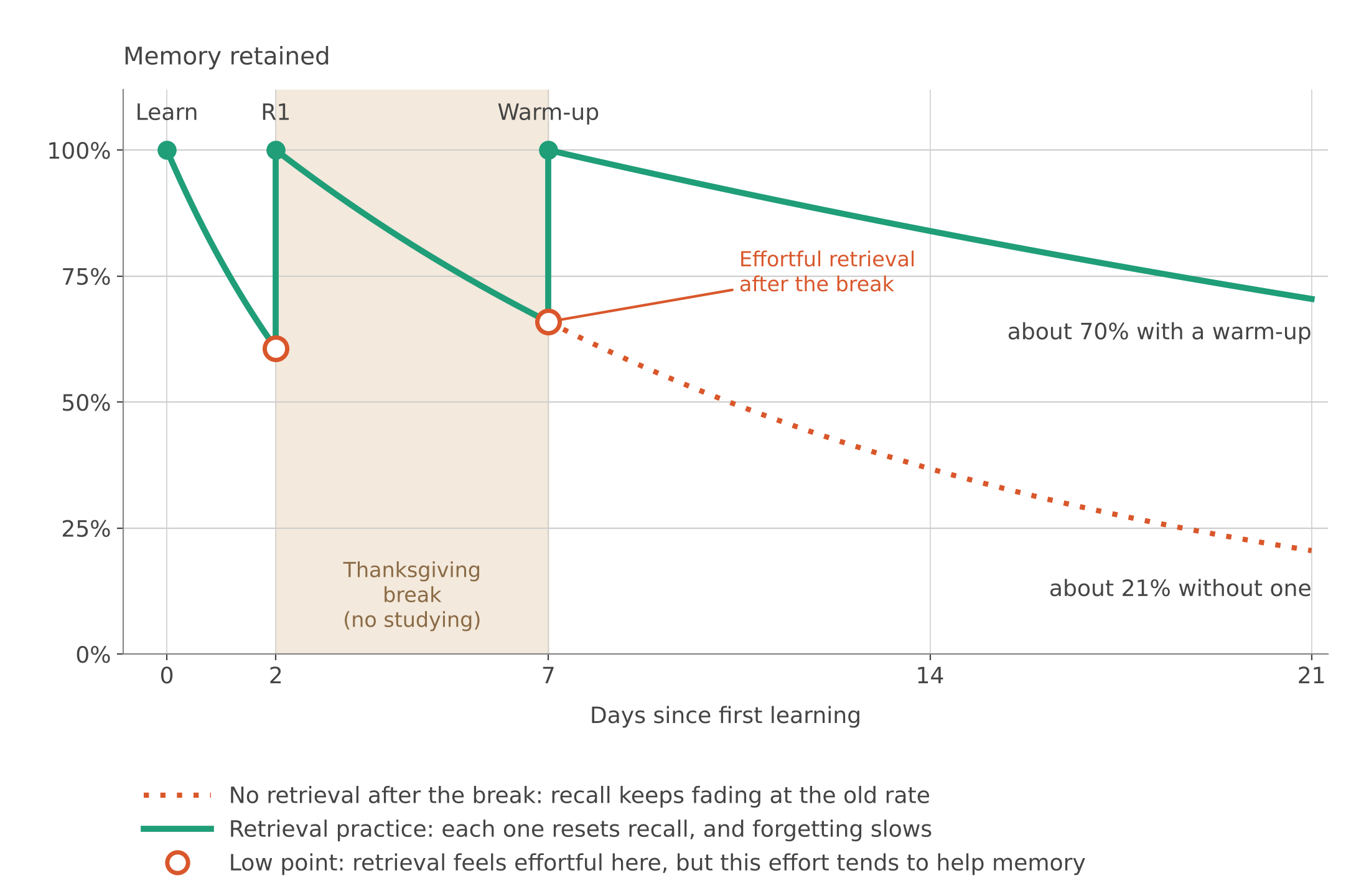
These curves are a simulation, not real data. They illustrate the general pattern reported in research on forgetting and spacing (Ebbinghaus, 1885/1913; Cepeda et al., 2006): memories fade over time, retrieving them brings them back, and each retrieval slows forgetting. The specific values were chosen for illustration and are not predictions.
There are other benefits too. Spacing out practice shifts the context in which the material is being practiced, which may also help produce durable learning and remembering (4). It is also important to take breaks in general. Stress can tax our cognitive resources and make it harder for us to retrieve what we know (5, 6). Sleep also plays an important role in consolidating new memories. If the break provides opportunities to catch up on sleep and destress, it can be beneficial for learning upon return as well. See this post on The Importance of Sleep for Memory and Cognition and this post, When Do the 6 Strategies for Effective Learning Work Best?
Of course, there is a limit to how much space we should put in between review or retrieval attempts. If the space is too long, and the information is completely forgotten, then students may need to relearn it. Likely there will be savings in relearning—i.e., it won’t take as long to learn it again as it did the first time (1). However, the benefits from spaced practice will likely be much less than they would have been, or possibly eliminated. The goal is to retrieve or at least review older material before it is completely forgotten to get the boost. Check out this post, Optimizing Your Learning Schedule, to learn more about this.
What to Do When You Return from Break?
Teachers, open the first class after break with a few minutes of low-stakes retrieval before reviewing or moving on. Try a quick “brain dump” or a few big-picture, ungraded questions. You can use what students can’t remember to target any review, and the students will get a boost from the spaced retrieval practice.
Students, remember that effort is a good thing. Try to recall from your memory first. Then, and only then, check your notes, ask your teacher, etc. In addition, retrieval may help your memory hold up under exam stress (see this post on retrieval practice and stress).
Parents, you can help by asking your child to explain one thing they have learned this fall. Having them describe and explain in their own words is additional practice. But remember, we do want to let them take the space to forget a bit before revisiting. So, skip any excessive quizzing and encourage your kids to take a restful break.
Enjoy the break, let a little forgetting happen, and come back ready to remember. Happy Thanksgiving!
References
(1) Ebbinghaus, H. (1913). Memory: A contribution to experimental psychology (H. A. Ruger & C. E. Bussenius, Trans.). Teachers College, Columbia University. (Original work published 1885)
(2) Cepeda, N. J., Pashler, H., Vul, E., Wixted, J. T., & Rohrer, D. (2006). Distributed practice in verbal recall tasks: A review and quantitative synthesis. Psychological Bulletin, 132(3), 354–380. https://doi.org/10.1037/0033-2909.132.3.354
(3) Bjork, E. L., & Bjork, R. A. (2011). Making things hard on yourself, but in a good way: Creating desirable difficulties to enhance learning. In M. A. Gernsbacher, R. W. Pew, L. M. Hough, & J. R. Pomerantz (Eds.), Psychology and the real world: Essays illustrating fundamental contributions to society (pp. 56–64). Worth Publishers.
(4) Smith, S. M., Glenberg, A., & Bjork, R. A. (1978). Environmental context and human memory. Memory & Cognition, 6(4), 342–353. https://doi.org/10.3758/BF03197465
(5) Shields, G. S., Sazma, M. A., & Yonelinas, A. P. (2016). The effects of acute stress on core executive functions: A meta-analysis and comparison with cortisol. Neuroscience & Biobehavioral Reviews, 68, 651–668. https://doi.org/10.1016/j.neubiorev.2016.06.038
(6) Shields, G. S., Sazma, M. A., McCullough, A. M., & Yonelinas, A. P. (2017). The effects of acute stress on episodic memory: A meta-analysis and integrative review. Psychological Bulletin, 143(6), 636–675. https://doi.org/10.1037/bul0000100