

GUEST POST: How Risk Measures Shape Public Understanding of Science
[Cover image by Mohamed Hassan from Pixabay]
By: Neal Asthana

Neal Asthana is a multi-disciplinary professional from the Washington D.C. area, with a lifelong passion for science & education. He is the founder of Caveat Scientia, a passion-project focused on bridging the gap between science research and public understanding. Neal has always been passionate about all fields of science, in areas of physics, biology, environmental and psychological science. Neal holds a Bachelor of Marine Science from the University of Sydney and a Master of Science from the University of Miami Rosenstiel School of Marine and Atmospheric Science (RSMAS). Neal has held many roles during his career, most notably as a marine technician and educator at the Smithsonian Marine Station, and aquarist at the Patricia & Phillip Museum of Science, and currently the co-owner and President of a global cybersecurity company called World Informatix. Beyond cybersecurity and science, he DJs and produces electronic dance music under the pseudonym Surge.DJ.
News and media headlines seem to be filled with hope and dread these days, with fast-spreading articles with bold claims of new research that proves a miraculous outcome of a new treatment or an increased change in harm linked to everyday exposure. The problems with how various media outlets communicate science are varied and numerous, including taking findings out of context, cherry picking results or just simply misunderstanding the conclusions. But perhaps most ubiquitous failures in science communication are the choice of risk measures that are used to convey findings to the public, which relies on relative risk instead of absolute risk.
In simple terms, relative risk can be thought of as “how much bigger or smaller is the risk compared to another group”, while absolute risk is “how likely is this to happen in the first place, or to me”?
Why Is Relative Risk the Norm?
The reason for using relative risk as the standard depends on the context of the communication. For news and blogs which rely on attention-grabbing headlines, relative risk conveys a sense of urgency and magnitude compared to absolute risk, leveraging how human psychology responds to statistics. A claim that a treatment cuts a risk in half, or how an everyday occurrence can double your risk of something is much more dramatic, even if the true underlying risk to an individual is small.
For scientific publications, relative risk is a logical way to convey the specific findings of the research, along with the statistical analysis that was conducted. Since the scientific method relies on testing hypotheses by comparing a control group against a condition in which a variable was manipulated, it makes perfect sense to utilize relative risk to summarize findings. The issue arises when these findings get communicated widely, and research turns into headlines.
How Relative Risk Can Mislead Us
Relative risk headlines can lead to widespread panic or crazes. Take for example the headline that spread across the globe like wildfire: “Alcohol consumption leads to a 61% increased risk of breast cancer in women”, which was based off a meta-analysis publication in the British Journal of Cancer (1). The stunning headline invoked fear in women worldwide and prompted nation-level discussions about the risks of alcohol consumption. While the figure isn’t technically false, the true impact of these findings gets lost in the choice of risk measures.
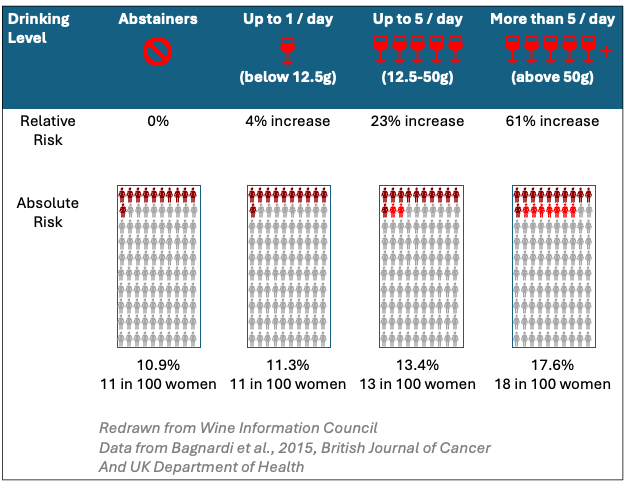
To understand this issue, let’s put this into a generalized figure to prove the point:
11 in 100 women who never drink will develop breast cancer
13 in 100 women who have between 1-5 drinks a day will develop breast cancer, or a 23% increase in risk.
18 in 100 women who have over 5 drinks a day will develop breast cancer, or a 61% increase in risk.
While a 61% increased risk seems like a huge impact, the equivalent absolute risk increase is 17.6%, or 7 people out of 100. This can be best represented in the following graphic:
Risk Communication – Not Just a Media Problem
The use of relative risk instead of absolute risk is problematic across various fields. The intersection between scientists and policy makers requires a careful deliberation about how science presents its results from a communication standpoint.
Ample research has been conducted into this phenomenon, with one study concluding that ‘risk obscures the magnitude of disease risk reduction in clinical research, and absolute risk reduction is shown to be a more precise and reliable measure of treatment and vaccine efficacy in clinical research studies’ (2). Another study posited that ‘presentations including absolute risk reductions were better than those including relative risk reductions for maximizing accuracy and seemed less likely than presentations with relative risk reductions to influence decisions to accept therapy’ (3).
An editorial in the Journal of Clinical Hypertension makes the case that issue also affects deeply scientific domains such as clinical research (4). The article gives an example of how a clinical reduction from a treatment can be 50% for two drugs, but as the data looked at vastly differently sized cohorts, the lifesaving results of one of those drugs can be orders of magnitude higher in absolute terms.
What Can We Do?
These examples demonstrate the skewing power of using relative risk over absolute risk. There has been significant discourse amongst the science community in how we should be communicating risks in a responsible manner. Using absolute risk is one of the core components of a more honest and transparent communication – a risk measure that should be presented alongside any statistical relative risk findings in any research paper. Additional recommendations include using graphics to demonstrate absolute risk in an easy-to-understand visual format, adding context and caveats to findings, and explaining limitations and applicability of the study in simple layman terminology.
Looking Towards the Future
In our modern era of hyperbole & hype in the media, scientific miscommunication and a building distrust in science and evidence, it is of paramount importance that there exists a more honest and clear way to communicate scientific research beyond the confines of published journals. By creating a new norm of standards for scientific communication across the industry, we can begin to address the widespread misuse and misunderstanding of scientific findings and start to rebuild trust with the public.
References:
(1) Bagnardi, V., Rota, M., Botteri, E., Tramacere, I., Islami, F., Fedirko, V., Scotti, L., Jenab, M., Turati, F., Pasquali, E., Pelucchi, C., Galeone, C., Bellocco, R., Negri, E., Corrao, G., Boffetta, P., La Vecchia, C. (2015). Alcohol consumption and site-specific cancer risk: A comprehensive dose-response meta-analysis. British Journal of Cancer, 112(3), 580-593. https://doi.org/10.1038/bjc.2014.579
(2) Brown, R. B. (2022). Relative risk reduction: Misinformative measure in clinical trials and COVID-19 vaccine efficacy. Dialogues in Health, 1, 100074. https://doi.org/10.1016/j.dialog.2022.100074
(3) Zipkin, D. A., Umscheid, C. A., Keating, N. L., Allen, E., Aung, K., Schuur, J. D., & Korenstein, D. (2014). Evidence-based risk communication: A systematic review. Annals of Internal Medicine, 161(4), 270–280. https://doi.org/10.7326/M14-0295
(4) Jiroutek, M.R., & Turner, J.R. (2019). Relative vs absolute risk and odds: Understanding the difference. Journal of Clinical Hypertension (Greenwich), 21(6), 859-861. https://doi.orb/10.1111/jch.13548