

GUEST POST: When the Body Enters the Classroom: Using Embodied Cognition to Teach Abstract Mathematics
By Karla Valencia-Quiroz and Alberto Guerrero-Velázquez

Karla Valencia-Quiroz is an educator and researcher with more than 15 years of experience across educational settings, with a particular focus on mathematics education, neurodiverse learning, and teacher professional development. Her research explores the intersection of embodiment, cognition, and learning, with a particular interest in how embodied cognition can be applied across the lifespan. Her interdisciplinary work brings together education, cognitive science, and applied approaches to explore how bodily experience can support meaningful learning and more accessible learning environments.

Alberto Guerrero-Velázquez is a philosopher, cognitive scientist, and educator with extensive experience in teaching and educational development. He has taught philosophy, ethics, bioethics, critical writing, and philosophy of artificial intelligence at different educational levels, and has worked in educational leaderships, teacher training, and the design and implementation of educational programmes. His research lies at the intersection of philosophy of mind and cognitive science, with a particular interest in autobiographical memory and its relationship to personal and social identity.
Most teachers have experienced the same situation: a student can read a large number correctly but struggles to explain why each digit has a different value. Constructing numbers is a key skill in the development of logical-mathematical thinking. It involves counting, abstraction, and symbolisation, and helps students use quantities flexibly when problem-solving. However, it is common to find students who can read and write numbers but do not fully understand their meaning or function. This difficulty becomes particularly evident when working with place value. Could it be that we are asking students to think abstractly before they have had enough opportunity to experience what they are trying to understand?
Mathematics in the classroom: Between practice and outcomes
In recent years, there has been a strong emphasis on promoting meaningful learning in mathematics. However, classroom experience and research suggest that students can sometimes perform mathematical procedures without fully understanding the ideas behind them. Understanding place value requires students to connect what numbers represent with the position of each digit, and difficulties with this can affect later mathematical learning (1).
Students may be able to work with ones, tens, hundreds, thousands, and millions while still finding it difficult to explain why a digit changes its value when its position changes. In some cases, students may also struggle with the meaning and function of zero (2).
This becomes particularly relevant in Years 5 and 6, when students are increasingly expected to work confidently with larger numbers and more abstract mathematical ideas. Research with sixth-grade students, for example, has shown that zero can still present conceptual difficulties at this stage of schooling (2). These difficulties can affect later learning, including understanding quantity, estimation, basic operations, and problem-solving.
In mathematics teaching, the development of abstract thinking is often prioritised from the early years, sometimes alongside a gradual reduction of concrete and experiential forms of learning. This is understandable: abstraction is an important part of mathematical thinking, and students are expected to become increasingly independent in working with symbols and concepts. However, the difficulties observed in the classroom invite us to reconsider how the experiences that support abstraction are built, and when students are actually ready to rely mainly on abstract representations.
If students can perform mathematics without understanding it, what exactly are they learning?
The body enters the classroom
This question points to a deeper issue: if students are expected to think abstractly, what kinds of experiences support the development of that capacity?
From the perspective of embodied cognition, learning does not occur solely in the mind, but through the interaction between body, environment, and action (3). Varela, Thompson, and Rosch proposed an approach to cognition in which knowing is closely connected to embodied experience and engagement with the world (3). Other work has also suggested that concepts are not formed in isolation from the world, but are shaped through relationships among perception, context, and environment (4).
This perspective changes the way we might think about learning abstract concepts. Understanding is not only about manipulating symbols in the mind; it can also be supported by experiences that give those symbols meaning.
Applied to teaching, principles of embodied cognition suggest that understanding complex concepts, such as those involved in mathematical thinking, can be supported when they are connected to bodily action. If learning is connected, at least in part, to experiences involving the body and environment, why is this foundation sometimes set aside when abstract thinking is expected to develop?
The transition from the concrete to the abstract does not necessarily have to be abrupt. Research on concreteness fading, for example, suggests that moving gradually from concrete representations toward more abstract ones can help learners transfer what they have learned (5). This research was conducted with university students, so it does not directly tell us how this approach should be used with younger children. However, it supports an important idea: concrete experience and abstract thinking do not have to be treated as separate or opposing ways of learning.
In practice, this means creating opportunities for students to engage with mathematical ideas through movement, interaction, and space. Students might use their bodies to represent numbers, move through space to explore relationships, or physically model ideas that are often taught only through symbols.
An example of the use of the body in processes of representation and abstraction is hand gesture. Hand movements can represent different aspects of an action, ranging from more complete movements to increasingly abstract representations. Novack et al. found that, although both physical action and gesture supported children´s learning of mathematical-equivalence problems, only gesture helped children successfully apply what they had learned to problems that required generalisation (6). This suggests that bodily representation may help students move from a specific action towards a more abstract understanding.
With this perspective in mind, Karla has designed a range of educational interventions to support the understanding of abstract ideas. One example is the Living Board, an approach developed from her teaching experience to foster understanding of place value through movement and spatial interaction (7).
The activity involves constructing a dynamic number system in which students take on different roles: some represent ones, others tens or hundreds, positioning themselves according to their function. As larger numbers are introduced, new “families”, such as thousands and millions, are incorporated and organised spatially.
For example, a student holding the number 5 represents “five” in the ones place, but becomes “fifty” or “five hundred” by moving to a different position. The shift is not only symbolic but physically experienced through movement. Proprioceptive and visual feedback reinforce the relationship between position and value: place value is enacted through action—it is not merely calculated, but experienced.
The important point is not that every mathematics lesson needs to become a physical activity. Rather, teachers can ask whether a concept that students are expected to understand abstractly might first benefit from being represented through movement, space, or gesture.
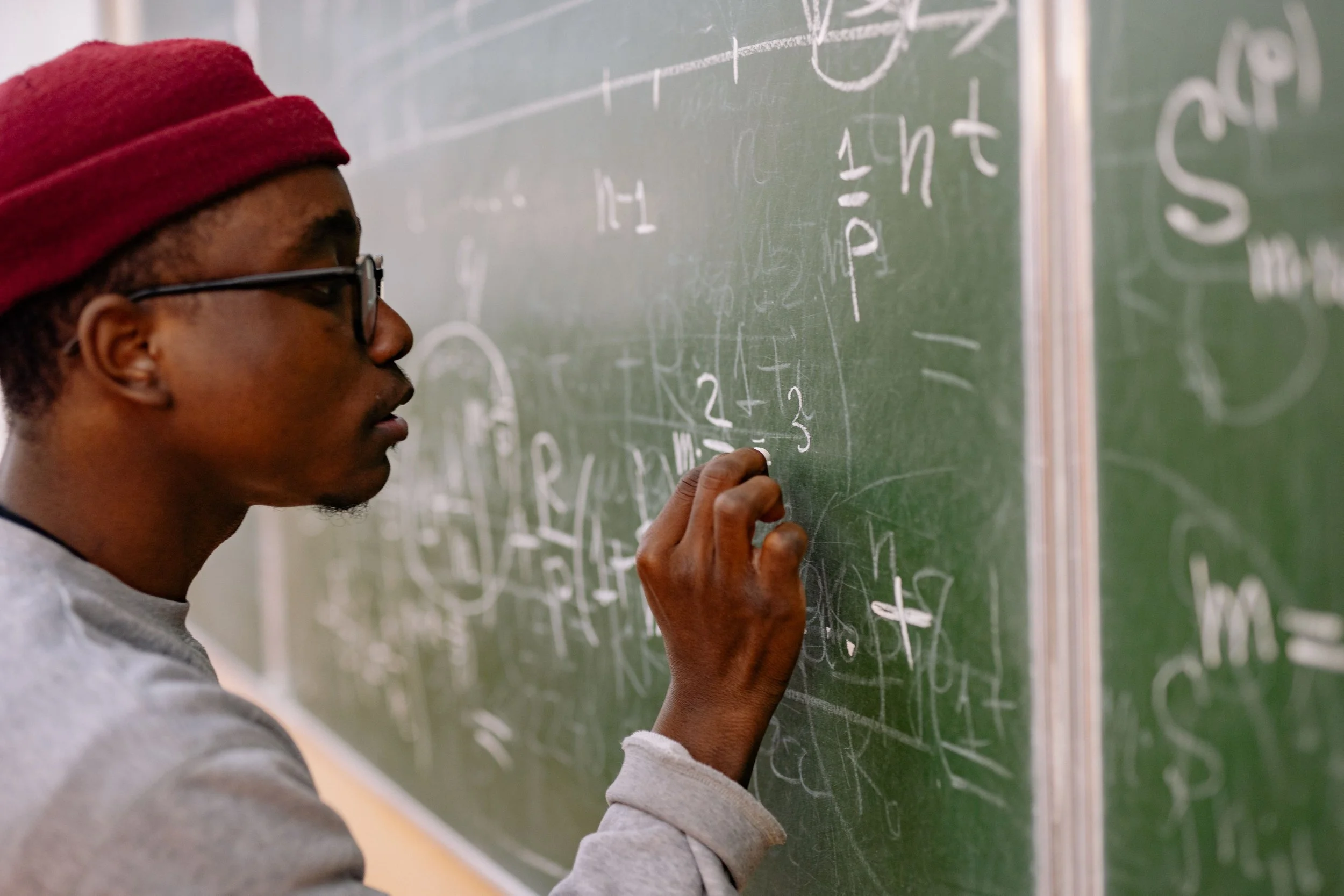
Image by Yan Krukau on Pexels
Embodied learning for diverse classrooms
The Living Board was particularly useful during its implementation with students who experienced difficulties with attention. During the activity, attention was directed towards coordinating bodily action while simultaneously engaging with concepts that can be difficult to grasp in abstract form. Regulating their own movement supported the organisation of thinking and created opportunities to build learning through experience.
This observation also connects with research on embodied physical activity in school settings. McClelland, Pitt, and Stein developed a classroom physical-activity intervention based on embodied cognition for pupils aged 7-13 and reported improvements in academic performance, particularly among students with lower initial achievement, as well as effects related to attention and self-control (8). This research does not specifically examine the Living Board or students with ADHD, but it provides useful evidence that bodily engagement can have educational value beyond simply making a lesson more active.
In our experience, students with other learning difficulties also found this approach a more accessible way to engage with abstract ideas. Understanding did not rely only on language or abstract explanation, but also on action. This provided an additional way into concepts that some students found difficult to approach through symbolic representations alone.
During the activity, students collaboratively construct numbers, read them aloud, correct one another, and analyse errors. When an element is missing from the board, they must decide how to represent it, creating an opportunity to explore the meaning and function of zero within numbers. Through these processes, students can begin to move away from memorised rules towards a more meaningful understanding of the number system.
The impact of the body in the classroom
Activities grounded in embodied experience provide students with opportunities to represent mathematical ideas through movement, engage in physical interaction, and explore concepts before formalisation. This approach also challenges a common assumption: that as students progress through school, they require less movement and more abstraction.
Reintroducing the body into students’ learning processes does not mean abandoning the development of abstract thinking. Rather, it means giving students experiences that can help them build that thinking. The fact that students are expected to become more abstract thinkers does not mean that bodily experience has stopped being relevant. Perhaps the transition from the concrete to the abstract is not about leaving the body behind, but about gradually transforming experience into more abstract ways of understanding.
For teachers, this opens an important possibility: to design learning experiences that not only deliver content, but also give students opportunities to understand it in deeper and more meaningful ways.
If mathematics is to be understood rather than merely performed, we must create conditions in which concepts can be experienced, not only explained. The body, far from being a secondary element, should remain a central medium of learning throughout life. Perhaps the challenge is not helping students move beyond the body, but helping them think through it.
Cover image by Peter Miklos on Pexels
References:
1. Medina Rodríguez, D. A. (2016). La comprensión del valor de posición en el desempeño matemático de niños. Avances en Psicología Latinoamericana, 34(3), 441–456. https://doi.org/10.12804/apl34.3.2016.01
2. Levenson, E., Tsamir, P., & Tirosh, D. (2007). Neither even nor odd: Sixth grade students’ dilemmas regarding the parity of zero. The Journal of Mathematical Behavior, 26(2), 83–95. https://doi.org/10.1016/j.jmathb.2007.05.004
3. Varela, F. J., Thompson, E., & Rosch, E. (1991). The embodied mind: Cognitive science and human experience. MIT Press.
4. Gabora, L., Rosch, E., & Aerts, D. (2008). Toward an ecological theory of concepts. Ecological Psychology, 20(1), 84–116. https://doi.org/10.1080/10407410701766676
5. McNeil, N. M., & Fyfe, E. R. (2012). “Concreteness fading” promotes transfer of mathematical knowledge. Learning and Instruction, 22(6), 440–448. https://doi.org/10.1016/j.learninstruc.2012.05.001
6. Novack, M. A., Congdon, E. L., Hemani-Lopez, N., & Goldin-Meadow, S. (2014). From action to abstraction: Using the hands to learn math. Psychological Science, 25(4), 903–910. https://doi.org/10.1177/0956797613518351
7. Valencia-Quiroz, K. M. (2021). La importancia de la cognición corporizada en el aprendizaje de las matemáticas: Un caso de éxito en la enseñanza de la construcción de cifras en niños de sexto grado de primaria. Atena Editora. https://doi.org/10.22533/at.ed.26821290411
8. McClelland, E., Pitt, A., & Stein, J. (2015). Enhanced academic performance using a novel classroom physical activity intervention to increase awareness, attention and self-control: Putting embodied cognition into practice. Improving Schools, 18(1), 83–100. https://doi.org/10.1177/1365480214562125